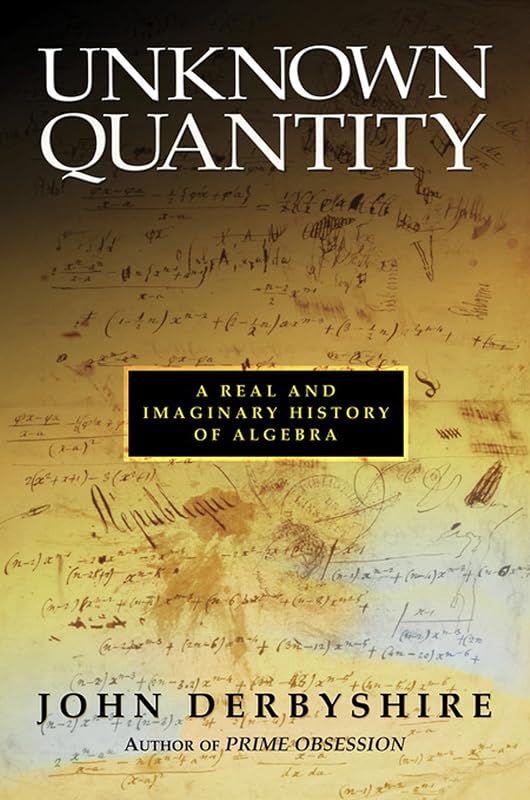

Unknown Quantity: A Real and Imaginary History of Algebra by John Derbyshire

Unknown Quantity: A Real and Imaginary History of Algebra

John Derbyshire
493 pages
National Academies Press
May 2007
Hardcover
Science WSBN
6
Readers
1
Reviews
1
Discussions
0
Quotes
Prime Obsession taught us not to be afraid to put the math in a math book. Unknown Quantity heeds the lesson well. So grab your graphing calculators, slip out the slide rules, and buckle up! John Derbyshire is introducing us to algebra through the ages -- and it promises to be just what his die-hard fans have been waiting for. "Here is the story of algebra." With this deceptively simple introduction, we begin our journey. Flanked by formulae, shadowed by roots and radicals, escorted by an expert who navigates unerringly on our behalf, we are guaranteed safe passage through even the most treacherous mathematical terrain. Our first encounter with algebraic arithmetic takes us back 38 centuries to the time of Abraham and Isaac, Jacob and Joseph, Ur and Haran, Sodom and Gomorrah. Moving deftly from Abel's proof to the higher levels of abstraction developed by Galois, we are eventually introduced to what algebraists have been focusing on during the last century. As we travel through the ages, it becomes apparent that the invention of algebra was more than the start of a specific discipline of mathematics -- it was also the birth of a new way of thinking that clarified both basic numeric concepts as well as our perception of the world around us. Algebraists broke new ground when they discarded the simple search for solutions to equations and concentrated instead on abstract groups. This dramatic shift in thinking revolutionized mathematics. Written for those among us who are unencumbered by a fear of formulae, Unknown Quantity delivers on its promise to present a history of algebra. Astonishing in its bold presentation of the math and graced with narrative authority, our journey through the world of algebra is at once intellectually satisfying and pleasantly challenging.
Join the conversation
Lennart Lopin
Lennart Lopin
2 years ago

I just love John Derbyshire’s work. His language is so amazing and completely pulls you in.

An excellent general history of algebra

Unfortunately but inevitably John Derbyshire's "Unknown Quantity" is nowhere near as good as his previous pop math book "Prime Obsession", but in saying this I am praising the latter and not disparaging the former. "Unknown Quantity" still rates the full five stars. "Prime Obsession" is laser focused on one problem (Riemann's hypothesis on an important characteristic of the zeta function) and on one man (Bernhard Riemann). Derbyshire then expands on the mathematical topic twice, first by explaining the context in which the hypothesis mattered (its relationship to prime numbers) and finally by taking a general look at the branch of mathematics called analysis. He does the same thing with the human side of his story: he presents Riemann's friends and colleagues and then he presents earlier and later analysts. This makes for a near perfect book, both topically and dramatically. "Unknown Quantity" on the other hand gives us a more general history of its subject, which is algebra. Derbyshire takes us from its beginnings in ancient Babylon and describes in detail how to decipher a sample problem found on cuneiform tablet. He then goes to Alexandria where Diophantus used the first notation using something like "x" to represent unknown quantities. It didn't catch on, and Arab mathematicians developed the field during the middle ages using word problems again. Early in the Renaissance Italians then took over the search for roots and found methods to solve roots of third and fourth degree polynomials. Descartes then invented analytic geometry and standardized the usage of x-y-z as our notation for unknown quantities. Newton contributed to the field, but his invention of calculus (yes, yes along with Leibniz) diverted attention away from algebra for two centuries. It was in the nineteenth century that algebra as we know it today took off. Mathematicians were getting comfortable with the square root of minus one and the Complex field of numbers extended from the Real field. ...

No quotes shared yet. Join BookLovers to share your favorite quotes!

Earn Points
Your voice matters. Every comment, review, and quote earns you reward points redeemable for Bitcoin.
Comment +5 pts Review +20 pts Quote +7 pts Upvote +1 pt
BookMatch Quiz
Find books similar to this one
About this book
Pages 493
Publisher National Academies P...
Published 2007
Readers 6