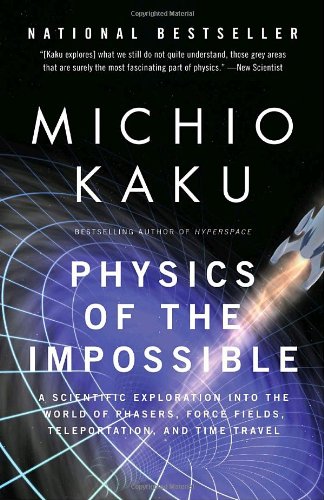
Physics of the Impossible: A Scientific Exploration into the World of Phasers, Force Fields, Teleportation, and Time Travel by Michio Kaku

Physics of the Impossible: A Scientific Exploration into the World of Phasers, Force Fields, Teleportation, and Time Travel

Michio Kaku
352 pages
Anchor
Jan 1971
Science WSBN
3
Readers
1
Reviews
0
Discussions
0
Quotes
Join the conversation

No discussions yet. Join BookLovers to start a discussion about this book!

Best non-fiction science book

This is the best non-fiction science book I have ever read in a long while. The theme of the book is to pick topics from pop-culture science books and movies and ponder how impossible the technology to achieve it, is. The impossibility is actually an assessment of how far in the future a form of technology would be available that would achieve, say, cloaks of invisibility or teleportation devices. Along the way, you will read history and tidbits about the personal lives of some great scientists. These wanderings make great reading for the layperson, especially when some topics like wormholes start getting heavy. Hyperspace, higher dimensions, curved space is near impossible to imagine. But Michio Kaku makes the reading interesting and relevant by frequently giving examples of practical applications. This is one reason I lost Bryan Greene (Elegant Universe) after the first 100 or so pages. There are topics I read that really made me think long after the book was over - how deep a foundation would you have to dig for a tower that extends out into space? Implications of time-travel. These are topics I have read in many other books (the ever great Sagan's Cosmos and classic Asimov books), but the coverage here was fascinating. The book never gets too technical. It is the kind of book that may set a young future Einstein's mind aflame. I strongly believe books like this should be mandatory in high school and undergraduate college. Many times, while sitting through Quantum Physics classes in college, I never understood the implications of the math. We memorized Shrodinger's equation without understanding its philosophical implications. Once when I asked the professor what negative mass actually implied, she painstakingly re-traced the math proving mass does become negative, leaving me as clueless as when I started. There are some drawbacks to the book. There are some obvious philosophical questions that are not addressed, except as a note in the appendix. One example i...

No quotes shared yet. Join BookLovers to share your favorite quotes!

Earn Points
Your voice matters. Every comment, review, and quote earns you reward points redeemable for Bitcoin.
Comment +5 pts Review +20 pts Quote +7 pts Upvote +1 pt
BookMatch Quiz
Find books similar to this one
About this book
Pages 352
Publisher Anchor
Published 1971
Readers 3