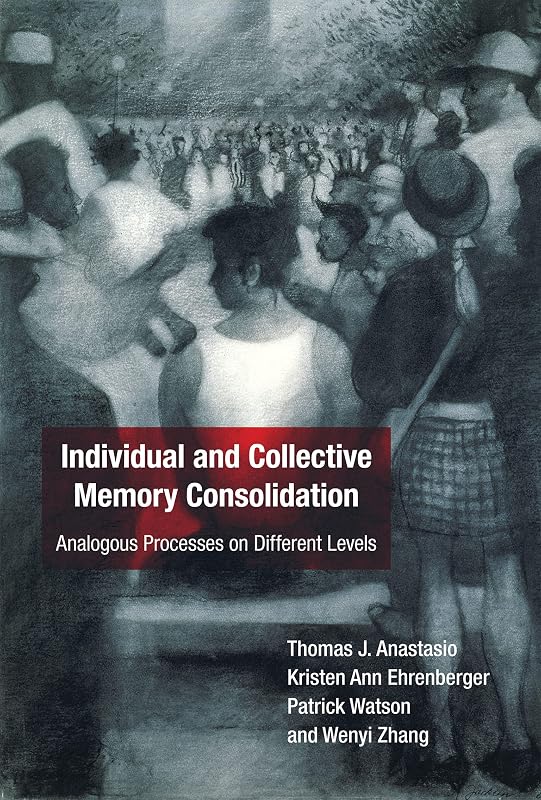
Individual and Collective Memory Consolidation: Analogous Processes on Different Levels by Thomas J. Anastasio

Individual and Collective Memory Consolidation: Analogous Processes on Different Levels

Thomas J. Anastasio
431 pages
The MIT Press
Feb 2012
Hardcover
Psychology & Philosophy WSBN
0
Readers
0
Reviews
0
Discussions
0
Quotes
An argument that individuals and collectives form memories by analogous processes and a case study of collective retrograde amnesia.We form individual memories by a process known as consolidation: the conversion of immediate and fleeting bits of information into a stable and accessible representation of facts and events. These memories provide a version of the past that helps us navigate the present and is critical to individual identity. In this book, Thomas Anastasio, Kristen Ann Ehrenberger, Patrick Watson, and Wenyi Zhang propose that social groups form collective memories by analogous processes. Using facts and insights from neuroscience, psychology, anthropology, and history, they describe a single process of consolidation with analogous - not merely comparable - manifestations on any level, whether brain, family, or society. They propose a three-in-one model of memory consolidation, composed of a buffer, a relator, and a generalizer, all within the consolidating entity, that can explain memory consolidation phenomena on individual and collective levels.

When consolidation is disrupted by traumatic injury to a brain structure known as the hippocampus, memories in the process of being consolidated are lost. In individuals, this is known as retrograde amnesia. The authors hypothesize a "social hippocampus" and argue that disruption at the collective level can result in collective retrograde amnesia. They offer the Chinese Cultural Revolution (1966-1976) as an example of trauma to the social hippocampus and present evidence for the loss of recent collective memory in mainland Chinese populations that experienced the Cultural Revolution.

Read more Continue reading Read less REVIEW
Individual and Collective Memory Consolidation constitutes... a clear and well-structured model of memory formation that bridges the gap between individual and collective memory studies.... Because of its clarity, erudition, and constant use of examples, it is apt and very informative for a general public interested in memory issues.

-- Metapsychology

What this book does, and does very well, is establish a firm and consistent analogy between individual and collective memory consolidation.... The cognitive scientist's analytical insights into personal memory formation prove applicable at the group level, while cultural theorists' more intuitive work in collective memory can, in turn, offer a vocabulary and model for describing brain states. The four authors... set themselves a herculean task in aiming to delineate a full-fledged analogy between these two kinds of memory, and they have more than met their own demands.... This is not only a compelling volume on memory, it is also a model of what interdisciplinary scholarship can be.

-- H-Net Reviews --This text refers to the hardcover edition. ABOUT THE AUTHOR
Thomas J. Anastasio is Associate Professor in the Department of Molecular and Integrative Physiology and member of the Beckman Institute for Advanced Science and Technology at the University of Illinois at Urbana-Champaign.

Kristen Ann Ehrenberger is an M.D./Ph.D. candidate in History at the University of Illinois at Urbana-Champaign.

Patrick Watson is a Ph.D. candidate in Cognitive Neuroscience at the University of Illinois at Urbana-Champaign.

Wenyi Zhang is a Ph.D. candidate in Anthropology at the University of Illinois at Urbana-Champaign. --This text refers to the hardcover edition. REVIEW
Individual and Collective Memory Consolidation offers a new synthesis of memory research, integrating theories within fields and building bridges between disciplines. Altogether the authors paint a compelling new picture of the ways in which experience gradually gives rise to knowledge, meaning, and construal, for each of us as individuals and for all of the groups we form.

-- James L. McClelland, Lucie Stern Professor and Director, Center for Mind, Brain, and Computation, Stanford University --This text refers to the hardcover edition. Read more Continue reading Read less
Join the conversation

No discussions yet. Join BookLovers to start a discussion about this book!

No reviews yet. Join BookLovers to write the first review!

No quotes shared yet. Join BookLovers to share your favorite quotes!

Earn Points
Your voice matters. Every comment, review, and quote earns you reward points redeemable for Bitcoin.
Comment +5 pts Review +20 pts Quote +7 pts Upvote +1 pt
BookMatch Quiz
Find books similar to this one
About this book
Pages 431
Publisher The MIT Press
Published 2012
Readers 0