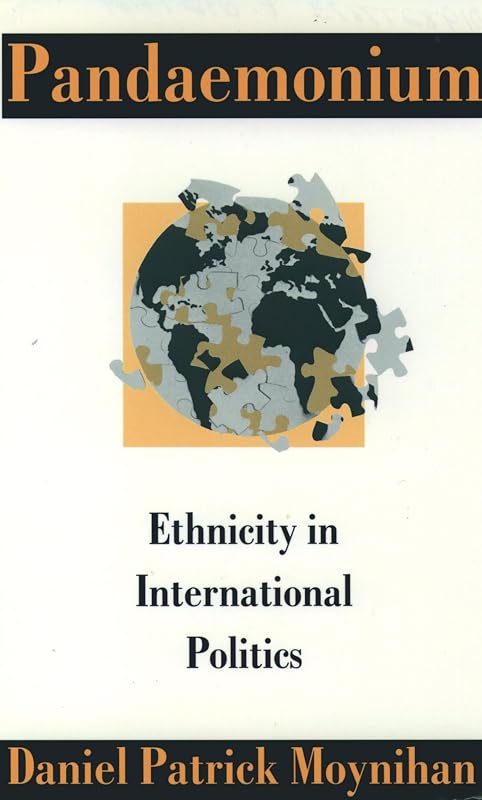


Pandaemonium: Ethnicity in International Politics by Daniel Patrick Moynihan

Pandaemonium: Ethnicity in International Politics

Daniel Patrick Moynihan
238 pages
Oxford University Press
Feb 1993
1st Edition
Literature & Fiction WSBN
0
Readers
0
Reviews
0
Discussions
0
Quotes
Ten years before the Soviet Union collapsed, Senator Daniel Patrick Moynihan stood almost alone in predicting its demise. As the intelligence community and cold war analysts churned out statistics demonstrating the enduring strength of the Moscow regime, Moynihan, focusing on ethnic conflict, argued that the end was at hand. Now, with such conflict breaking out across the world, from Central Asia to South Central Los Angeles, he sets forth a general proposition: Far from vanishing, ethnicity has been and will be an elemental force in international politics. Drawing on a lifetime of scholarship, the Senator provides in Pandaemonium a subtle, richly textured account of the process by which theory has grudgingly begun to adapt to reality. Moynihan--whose previous studies range over thirty years from Beyond the Melting Pot (with Nathan Glazer) to the much acclaimed On the Law of Nations--provides a deep historical look at ethnic conflict around the globe. He shows how the struggles that now absorb our attention have been going on for generations and explain much of modern history. Neither side in the cold war grasped this reality, he writes. Neither the liberal myth of the melting pot nor the Marxist fantasy of proletarian internationalism could account for ethnic conflict, and so the international system stumbled from one set of miscalculations to another. Toward the close of World War I, Woodrow Wilson declared the "self-determination of peoples" to be an Allied goal for the peace. Toward the end of World War II, Josef Stalin inserted "self-determination of peoples" into Article I of the United Nations Charter, defining "The Purposes" of the new world organization. This process has been going on ever since. The first phase, the breaking up of empire, was relatively peaceful. The second phase, presaged by the 1947 partition of India, is certain to be far more troubled, as fifty to a hundred new countries emerge. Moynihan argues, however, that a dark age of "ethnic cleansing" is not inevitable; that the dynamics of ethnic conflict can be understood, anticipated, moderated. Ethnic pride can be a source of dignity and of stability, if only its legitimacy is accepted. Moynihan writes in a learned, reflective voice: at times theoretical, but always in the end directed to issues of fierce immediacy. A splendid achievement, Pandaemonium begins the re-education of Western diplomacy.
Join the conversation

No discussions yet. Join BookLovers to start a discussion about this book!

No reviews yet. Join BookLovers to write the first review!

No quotes shared yet. Join BookLovers to share your favorite quotes!

Earn Points
Your voice matters. Every comment, review, and quote earns you reward points redeemable for Bitcoin.
Comment +5 pts Review +20 pts Quote +7 pts Upvote +1 pt
BookMatch Quiz
Find books similar to this one
About this book
Pages 238
Publisher Oxford University Pr...
Published 1993
Readers 0