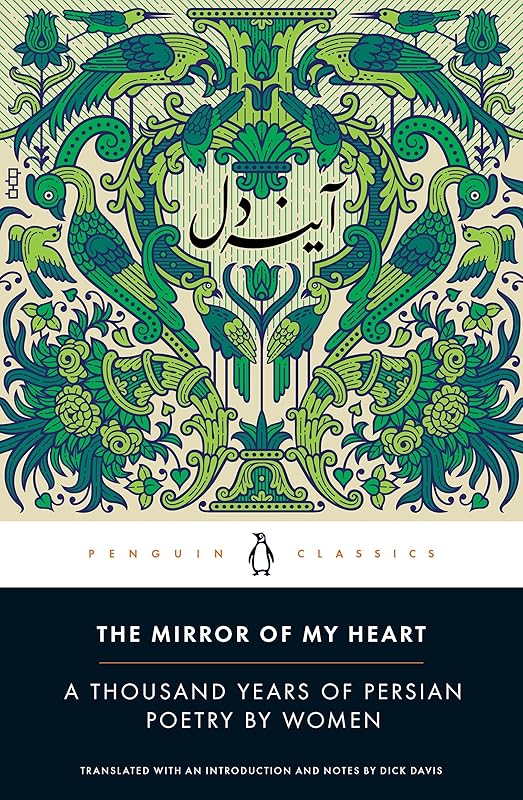
An anthology of verse by women poets writing in Persian, most of whom have never been translated into English before, from acclaimed scholar and translator Dick Davis.
A Penguin Classic
The Mirror of My Heart is a unique and captivating collection of eighty-three Persian women poets, many of whom wrote anonymously or were punished for their outspokenness. One of the very first Persian poets was a woman (Rabe'eh, who lived over a thousand years ago) and there have been women poets writing in Persian in virtually every generation since that time until the present. Before the twentieth century they tended to come from society's social extremes--many were princesses, some were entertainers, but many were wives and daughters who wrote simply for their own entertainment, and they were active in many different countries - Iran, India, Afghanistan, and areas of central Asia that are now Uzbekistan, Turkmenistan, and Tajikistan. From Rabe'eh in the tenth century to Fatemeh Ekhtesari in the twenty-first, the women poets found in The Mirror of My Heart write across the millennium on such universal topics as marriage, children, political climate, death, and emancipation, recreating life from hundreds of years ago that is strikingly similar to our own today and giving insight into their experiences as women throughout different points of Persian history. The volume is introduced and translated by Dick Davis, a scholar and translator of Persian literature as well as a gifted poet in his own right. Read more Continue reading Read less REVIEW
"In every respect, The Mirror of My Heart is outstanding. Reading it one discovers a whole tradition of love poetry, epigram and elegy, movingly brought into English and then beautifully printed and bound by Washington's own Mage Publishers. Most important now, this anthology reminds us how much we all share the same joys, the same sorrows."
-Michael Dirda, The Washington Post ABOUT THE AUTHOR
Dick Davis is a translator, a poet, and a scholar of Persian literature who has published more than 20 books. He is currently a professor of Persian at Ohio State University and a fellow of the Royal Society of Literature. His translations from Persian includeThe Lion and the Throne,Fathers and Sons, andSunset of Empire: Stories from the Shahnameh of Ferdowsi, vols. I, II, III. EXCERPT. REPRINTED BY PERMISSION. ALL RIGHTS RESERVED.
Rabe'eh
Tenth century
Rabe'eh's family claimed descent from Arabs who had entered Iran during or after the seventh-century conquest of the country. By the time Rabe'eh was born, her father had become ruler of Balkh in what is now northern Afghanistan. Almost no information about her life has come down to us, although the lurid story of her demise is well known: after her father died she is said to have carried on a secret love-affair with a slave or servant at what was now the court of her brother, Hareth. The liaison was discovered, and Hareth cut her throat and left her in a bath-house where she bled to death; her lover then killed Hareth and committed suicide.
*
The garden shows so many flowers, as though
Mani had painted their resplendent glow
Dawn's breezes never bore Tibetan musk,
How is the world so musky when they blow?
Are Majnun's eyes within the clouds, that they
Shed Layli's cheeks' hue on each rose below?
Like wine within an agate glass, his tears
Have filled each tulip with their crimson glow
Raise up the wine bowl, raise it generously
Since bad luck dogs deniers who say "No"
Narcissi glow with silver and with gold
It's Kasra's crown their shining petals show
Like nuns in purple cowls the violets bloom
Do they turn into Christians as they grow?
*
My hope's that God will make you fall in love
With someone cold and callous just like you
And that you'll realize my true value when
You're twisting in the torments I've been through.
*
His love has caught me once again-
I've struggled fiercely, but in vain.
(Well, sobersides, explain to me
Just who can swim love's shoreless sea!
To reach love's goal you must accept
All you instinctively reject-
See ugliness as beauty, eat
Foul poison up and call it sweet.)
I jerked my head to work it loose,
Not knowing all this would produce
Was further tightenings of the noose.
*
I'm drunk with love to know my love is here tonight
And that I'm freed from sorrow and from fear tonight;
I sit beside my love, and earnestly I say,
"God, make the key to morning disappear tonight!"
Mahsati
c.1089-1159
Mahsati was said to be from Ganjeh, in what is now independent Azerbaijan, and to have sought employment as a scribe at the court of the Seljuk king Sanjar, who ruled from 1118 to 1157. She became known as the writer of a considerable number of short poems, and it is likely that many otherwise anonymous poems from the medieval period that seemed to be by women became attributed to her.
*
As wounded, and caught in your snare-there's no one like me
As driven by you to despair-there's no one like me
So many, so eagerly, vie for your love . . .
As steadfastly faithful I swear-there's no one like me.
*
If you're a hypocrite, and bow your face in prayer-what use is that?
Once poison's reached into your soul, remedial care-what use is that?
Showing yourself to everyone as though you're virtuous and moral,
If you're all filth within, the spotless cloak you wear-what use is that?
*
Love makes a lion cower in its lair-
It is a sea of wonders, strange and rare;
At times its kindly ways delight our souls
At times the smell of blood is in the air.
*
O son of Ganjeh's preacher, my advice to you
Is: "Take the wine glass in your hand, give joy its due . . ."
Your piety and heresy don't interest God-
Seek pleasure in this world now, while you're able to.