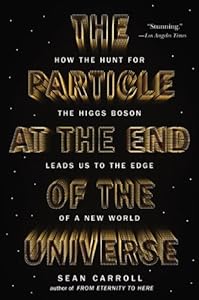
The Particle at the End of the Universe: How the Hunt for the Higgs Boson Leads Us to the Edge of a New World by Sean Carroll

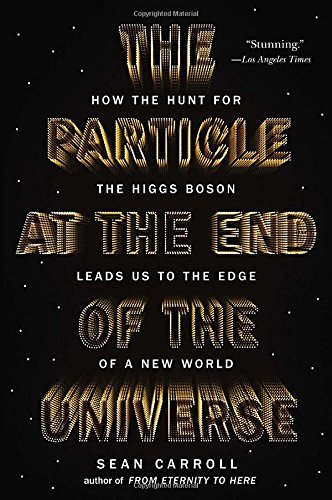
The Particle at the End of the Universe: How the Hunt for the Higgs Boson Leads Us to the Edge of a New World
Sean Carroll
368 pages
Dutton
Jan 2000
Paperback
Science WSBN
3
Readers
1
Reviews
0
Discussions
0
Quotes
Join the conversation

No discussions yet. Join BookLovers to start a discussion about this book!

Sparkling account of the hunting of the Higgs

Many of us remember where we were during key world events; particle physicists would likely remember where they were on July 4, 2012. That was the day the Higgs boson was discovered at the Large Hadron Collider (LHC) in Geneva. By any measure it was one of the most momentous discoveries in physics, perhaps in all of science. But what exactly is the Higgs boson? Why is it important? And how was it discovered? In this engaging and informative book Caltech physicist Sean Carroll sheds light on all these aspects of the Higgs discovery. Carroll's book can be roughly divided into three parts. In the first part, after giving us a brief overview of particle physics describing relativity, quantum mechanics, the Standard Model and the discovery of the twelve elementary particles that make up the universe, Carroll plunges into a description of the giant particle accelerators that have made possible our understanding of nature's fundamental building blocks. Personally I found this part most enjoyable, since it's a little more accessible than the theoretical part. Carroll tells us about the stupendous engineering challenges involved in the building of the LHC and takes us on a nice little tour of its interior. There's all kinds of fascinating and amusing stuff here; the lead tungstate crystals in the detectors that took ten years to grow, the earlier particle accelerator whose workings were affected by the moon's tides, the baguette dropped by a bird that temporarily created electrical problems, the helium "explosion" caused by high voltage that crippled the machine for months, the physicist whose face was exposed to an intense beam of protons and who still escaped relatively unscathed. The sheer size and complexity of the ten-thousand pound detectors - ATLAS and CMS - beggar belief and the smooth functioning of these hunks of metal, plastic and electronics is a resounding tribute to human ingenuity and collaboration. Carroll is very good at describing the structure and funct...

No quotes shared yet. Join BookLovers to share your favorite quotes!

Earn Points
Your voice matters. Every comment, review, and quote earns you reward points redeemable for Bitcoin.
Comment +5 pts Review +20 pts Quote +7 pts Upvote +1 pt
BookMatch Quiz
Find books similar to this one
About this book
Pages 368
Publisher Dutton
Published 2000
Readers 3