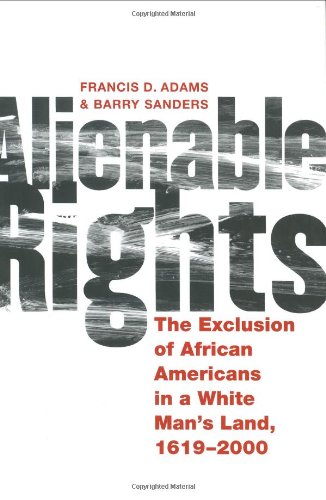
Alienable Rights: The Exclusion of African Americans in a White Man's Land, 1619-2000 by Francis D. Adams

Alienable Rights: The Exclusion of African Americans in a White Man's Land, 1619-2000

Francis D. Adams
384 pages
Harper
Nov 2003
Hardcover
Politics WSBN
0
Readers
0
Reviews
0
Discussions
0
Quotes
In a devastating narrative that spans more than three centuries, from colonial times to the present day, Alienable Rights reveals how whites have excluded blacks from virtually every area of American life, denying them full citizenship and equality.Brought to America early in the seventeenth century, the first slaves were treated in much the same way as indentured white servants who had come from England. After only a few years, however, whites ostracized blacks, who were viewed as an inferior race, and passed laws making their enslavement permanent, denying even free blacks the most basic rights enjoyed by whites. Though many slaves fought honorably in the Revolutionary War, earning their freedom, the Constitution (1787) sanctioned slavery, making it -- in the words of one of the signers -- the document's "most prominent feature." Three years later, Congress passed the nation's first naturalization act, limiting citizenship to "free white persons" only.Throughout the country, a popular colonization movement developed, attracting whites who hoped to make the United States a purely white nation by transporting all blacks to Africa or the Caribbean. Though the Civil War ended slavery, the subsequent congressional attempt to remake southern society during Reconstruction failed because whites in both the North and the South were unwilling to accept blacks as equals, with the same rights to vote, to attend school, and to move freely throughout American society. Instead, the Supreme Court approved the subterfuge of "separate but equal," which allowed state governments to maintain racial segregation by providing blacks with inferior institutions of their own.The "Jim Crow" system was overturned by the civil rights movement that followed World War II, but much of the progress of the 1960s and 1970s was blunted by an angry backlash in the 1980s.The authors contend that the drive for African American equality has never had the support of the majority of white Americans. Racial progress has come in brief historical bursts when a committed militant minority -- abolitionists, radical Republicans, civil rights activists -- stirred the nation to action, pressuring it to change; but, invariably, advances have been followed by concerted efforts to restore white privilege.
Join the conversation

No discussions yet. Join BookLovers to start a discussion about this book!

No reviews yet. Join BookLovers to write the first review!

No quotes shared yet. Join BookLovers to share your favorite quotes!

Earn Points
Your voice matters. Every comment, review, and quote earns you reward points redeemable for Bitcoin.
Comment +5 pts Review +20 pts Quote +7 pts Upvote +1 pt
BookMatch Quiz
Find books similar to this one
About this book
Pages 384
Publisher Harper
Published 2003
Readers 0