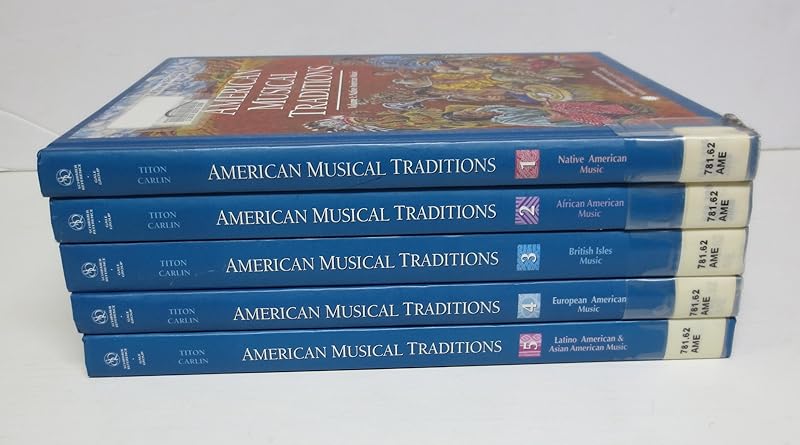
American Musical Traditions
Jeff Todd Titon
Prepared in conjunction with the Smithsonian/Folkways Archives, this set highlights the contributions of Native American, European-American, African American and immigrant groups (including Asian, Hispanic, Western and Eastern European cultures) to our rich musical heritage. Within each volume, different groups or genres of music are examined in terms of how they are performed. Maps, charts and photos show how the music has grown and spread and the interrelationships between musicalcultures. Biographies of musicians are included in sidebars, and terms are defined throughout the text.
Included in the set are five volumes:
* Volume I: Native American Music * Volume II: African-American Music
* Volume III: British Isles Music
* Volume IV: European American Music
* Volume V: Latino and Asian-American Music For more information on this product click here. 01
Read more Continue reading Read less FROM SCHOOL LIBRARY JOURNAL
Grade 9 Up-As Titon states in his introduction, this work is not intended to be an exhaustive study but rather a "spicy stew, a mosaic, and a mix" giving a flavor of the wide range of regional and ethnic music still evolving in our country. Separate volumes cover the traditions of Native Americans, African Americans, the British Isles, European Americans, and Latino and Asian Americans. Essay topics range from the general ("Chicago Blues," "Mexican Mariachi") to the highly specialized ("Music of the Old Regular Baptists of Central Appalachia," "Trinidadian Percussion Traditions in Miami") and include articles on specific instruments (autoharp, button box accordion) and musicians. Some of the authoritative essays were commissioned especially for this publication, while others were taken from the liner notes of Smithsonian Folkways Recordings or program booklets created for the annual Smithsonian Folklife Festival. Each essay concludes with a brief bibliography; information on accessing related recordings via two Web sites is found in the introduction. Black-and-white archival photos accompany most of the two- to eight-page essays, with a few more recent color shots scattered throughout the volumes. Numerous maps identify the regions being described and the locations of tribes or ethnic communities within those regions. Some maps are so specific that they pinpoint the hometowns of particular musicians. This is an excellent resource for large public or secondary school libraries, particularly those with sizable music collections and those located in communities with active local folk-music scenes.
Ginny Gustin, Sonoma County Library System, Santa Rosa, CA
Copyright 2002 Cahners Business Information, Inc. FROM BOOKLIST
Imagine that you have the entire Smithsonian FolkwaysRecordings collection in the jukebox and further imagine that sittingaround you in the pub are the people who wrote the liner notes, all ina talkative mood, explaining the history, context, and instruments asyou listen to the music. American Musical Traditions may be theclosest you will get to that experience.This is not a traditionalA-Z encyclopedia of music but rather a collection of more than 100essays that was conceived to "reflect recent research by folkloristsand ethnomusicologists on the one hand, and the holdings of theSmithsonian Institution's Center for Folklore and Cultural Heritage onthe other." These essays are not aimed only at the music scholar butat all who would like to enjoy a deeper understanding of U.S. musicalheritage. The Folkways catalog number is included in selected essays,allowing the reader to access samples of the music on theSmithsonian's Web site.
Native American music is the subject ofvolume 1, with volume 2 covering African American music, volume 3 themusic of the British Isles, volume 4 European American music, andvolume 5 Latino American and Asian American music. The editors have"selected representative communities and musical genres to give anidea of the range of traditional music in the United States." Essaystitled "Caribbean Percussion Traditions in Miami"; "Diwali in Seattle:The Joyous Traditions Continue"; and "The Gandy Dancer Speaks: Voicesfrom Southern Black Railroad Gangs" give an idea of the set'scoverage. The opening introduction is repeated in each volume, as arethe table of contents and the indexes to all five volumes. At thebeginning of each essay is a short biographical paragraph about theauthor. At the end of each essay are a bibliography and occasionally adiscography and videography. There is an additional bibliography atthe end of each volume. Throughout the text, some words are in boldtype, with definitions provided in a glossary at the end of eachvolume for words in that volume. Colorful maps and historicphotographs add to the richness of the set.
This work is not for anaudience looking for two pages on Celtic music, but it is forlibraries with strong music collections or that want to provide asource of unique information for traditional or folk musicians intheir communities. Though there is overlap with the more scholarly andcomprehensive "United States and Canada" volume of The GarlandEncyclopedia of World Music (1994) , American Musical Traditionstreats some topics in greater detail, and students may find it moreaccessible. Just be sure to have an Internet connection nearby withheadphones so that users can listen to the Folkwayssamples. RBB
Copyright American Library Association. All rights reserved
Read more Continue reading Read less